_edited.png)


Zumba vs. Traditional Cardio: Which Is Better for Your Brain Health and Joy?
- Autumn Chastain
- 4 days ago
- 5 min read
Have you ever found yourself staring at the timer on a treadmill, watching the seconds crawl by like they’re stuck in molasses? You’re doing the work, you’re hitting your target heart rate, and you’re "checking the box" for your health. But are you actually feeling alive?
For many high-achieving women, fitness often becomes another item on an overstuffed to-do list. We choose "traditional" cardio: running, cycling, or the elliptical: because it’s efficient and easy to track. But there is a growing conversation in the wellness world about what we might be leaving on the table when we choose the repetitive over the rhythmic.
When it comes to your brain health and your daily dose of joy, is a standard gym session enough, or should you be looking for Houston Zumba classes to shake things up? Let’s dive into the science of the "dance brain" and why your soul might be craving a different kind of movement.
The "Check-the-Box" Trap: Why Traditional Cardio Can Feel Heavy
We’ve all been there. You lace up your sneakers, head to the gym, and spend 45 minutes in a linear motion. Don’t get me wrong: traditional cardio is incredible for your heart. It builds endurance, burns calories, and provides a predictable way to manage stress.

However, the problem for many of us isn't the physical effort; it’s the mental monotony. When your body is on autopilot, your mind often wanders back to your emails, your kids’ schedules, or that presentation you have on Monday. Instead of being a break from your stress, the treadmill becomes a place where you simply ruminate at a higher heart rate.
If you feel like your fitness routine is lacking a "spark," it’s likely because you aren't engaging your brain’s creative and social centers. This is where the magic of dance-based fitness comes in.
Your Brain on Zumba: More Than Just a Dance Party
When you step into a Zumba class, your brain has to work in a completely different way than it does during a solo run. This isn't just about "getting a sweat on"; it’s about neuroplasticity.
1. The Coordination Challenge
In a traditional cardio session, the movement is repetitive. In Zumba, the movement is multidimensional. You are constantly switching between rhythms: Cumbia, Salsa, Reggaeton, and Merengue. Your brain has to coordinate your arms, your feet, and your core, all while keeping time with the beat. This "dual-tasking" strengthens the neural pathways between your brain and your muscles, improving your visuospatial memory and reaction time.
2. Memory and Cognitive Reserve
Learning choreography: even simple, follow-along moves: requires your brain to store and retrieve information in real-time. Studies have shown that dance-based fitness can actually improve "response inhibition" and executive function. For a high-achieving woman navigating life transitions, this kind of mental agility is a superpower. It’s part of why I integrate these concepts into my holistic wellness program to help women move from burnout to brilliance.

The Joy Factor: Why Rhythm Beats Repetition
Let’s talk about joy. Joy isn't just a "nice-to-have"; it is a physiological necessity for long-term health. When you enjoy your workout, your body lowers cortisol (the stress hormone) more effectively than when you’re forcing yourself through a "grit-it-out" session.
The Endorphin "High" vs. The Dance "Glow"
Traditional cardio gives you an endorphin rush, often called the "runner’s high." It’s great! But Zumba adds a layer of intrinsic motivation. Because the music is upbeat and the atmosphere is festive, you’re not just working out to reach a goal: you’re working out because the movement itself feels like a reward.
When you find yourself smiling in the middle of a high-intensity track, that’s your brain releasing dopamine and oxytocin. This is the foundation of reconnecting with your body, moving away from "punishment fitness" and toward "joyful movement."
Community: The Secret Ingredient to Consistency
One of the biggest differences between traditional cardio and Zumba is the social component. While you can certainly run with a friend, the collective energy of a dance floor is hard to replicate.
There is a concept called "collective effervescence": the feeling of belonging and excitement that happens when a group of people moves in sync to music. This social connection is a massive booster for mental health. It’s the same reason why our Stryd Walk Club is so successful; when you have a community waiting for you, fitness stops being a chore and starts being a highlight of your week.

Where to Find Your Flow: Houston Zumba Classes
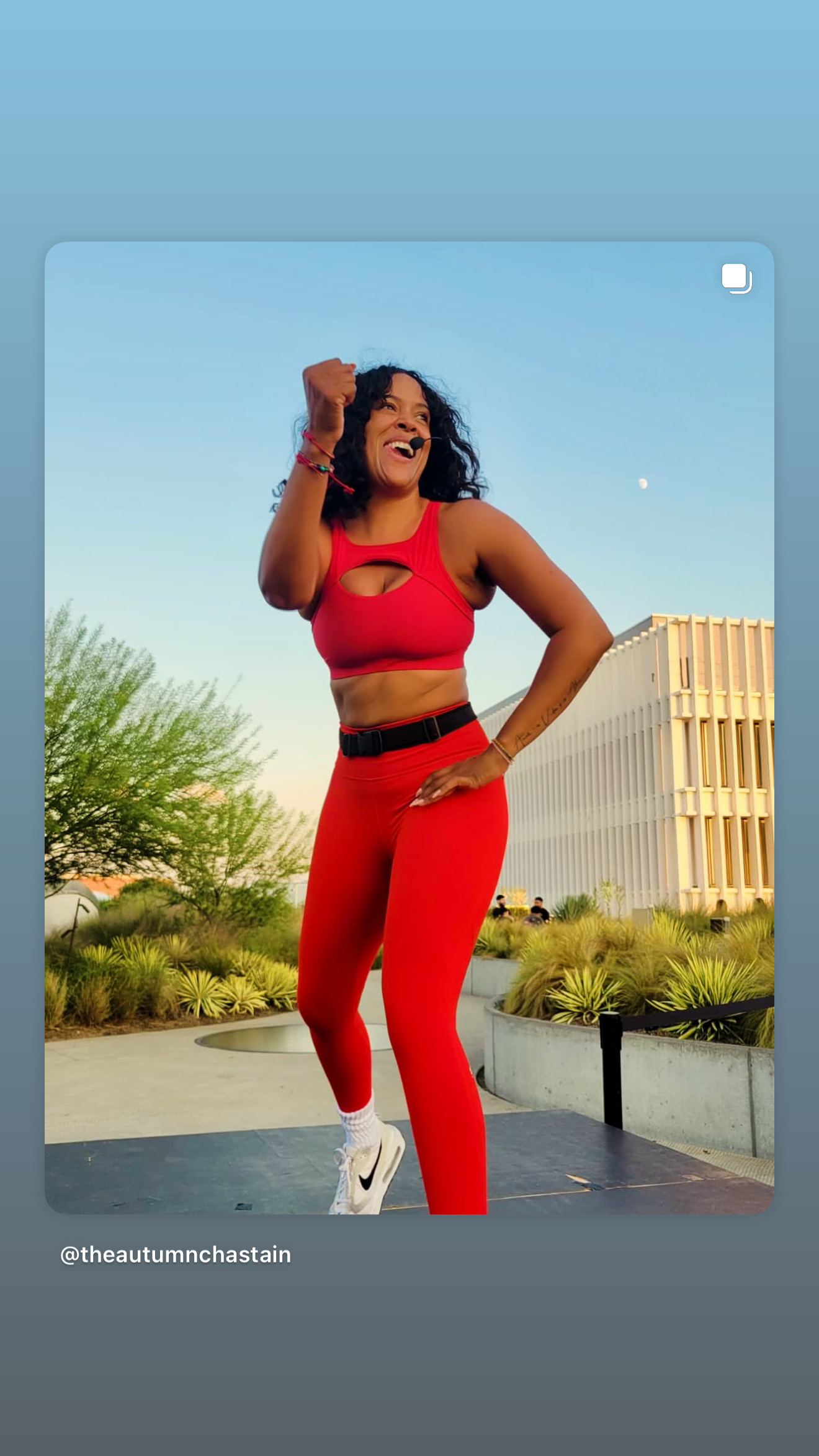
If you’re ready to trade the treadmill for the dance floor, I would love to see you in person! I’ve designed my schedule to make sure we can move together in some of the most vibrant spots in the city.
Mark your calendars for my current Zumba teaching schedule:
POST Houston: Join me on the first Thursday of every month for a high-energy session with incredible views.
Trebly Park: For the rest of the month, I teach at 6:30 PM on every other Thursday.
Trebly Park is located in the heart of downtown Houston (1515 Fannin St), and it is the perfect place to shake off the workday stress under the open sky. Whether you are a seasoned dancer or have "two left feet," my classes are about expression, not perfection.

Comparison: Which One Should You Choose?
Feature | Traditional Cardio (Run/Bike) | Zumba / Dance Fitness |
Primary Focus | Physical Endurance | Cognitive Agility + Joy |
Brain Benefit | Stress Relief | Neuroplasticity & Memory |
Social Vibe | Usually Solitary | Community-Driven |
Mental Effort | Low (Autopilot) | High (Choreography/Rhythm) |
Joy Levels | Goal-Dependent | Experience-Dependent |
The Best of Both Worlds
Does this mean you should never run again? Of course not! The most effective holistic wellness program is one that balances different types of movement.
Maybe you keep your morning walks or runs for quiet reflection, and you add a weekly Zumba class to "wake up" your brain and reconnect with your community. The key is to listen to your body. If you feel drained, bored, or disconnected, it might be time to swap a gym session for a dance session.
Take the First Step (or Dance Move)
You deserve a fitness routine that fills your cup instead of just draining your energy. Whether it’s joining us for Zumba under the sun or diving deeper into your personal growth through my Presence coaching, the goal is the same: to help you thrive in your prime.
So, what’s it going to be this week? Will you stay on the treadmill, or will you meet me at Trebly Park to find your rhythm?
Remember: progress takes time, and perfection is never the objective. The objective is to choose yourself: and to have a whole lot of fun while doing it.
I’ll see you on the dance floor! 💃✨
Comments