_edited.png)


Do You Really Need That Fitness Tracker?
We’ve all been there. You’re halfway through a glorious, sun-drenched hike, your lungs are pumping with fresh air, and you feel like an absolute powerhouse. Then, you glance down at your wrist.
“Only 4,000 steps? I’ve been walking for an hour! Is this thing even on?”
Suddenly, the endorphin rush vanishes, replaced by a nagging sense of failure. You weren't "productive" enough. Your workout didn't "count." In that split second, you handed over your power to a piece of glass and silicone that doesn't know a thing about how your soul feels: it only knows how many times your arm swung back and forth.
In our data-driven world, we’ve become obsessed with the "quantified self." We track our sleep, our heart rate variability, our calories, and our steps. But here is the million-dollar question: Are these devices actually helping us get healthy, or are they just giving us something else to be anxious about?
As a lifestyle wellness coaching professional, I’ve seen both sides of the coin. Let’s dive into the witty, sometimes frustrating, and ultimately liberating truth about fitness trackers.
The Tracker Trap: When Stats Steal Your Joy
Don’t get me wrong: fitness trackers can be fantastic tools for accountability. If you’re someone who genuinely has no idea how much you move in a day, seeing that number can be the wake-up call you need to take the stairs instead of the elevator. Research even suggests that tracker users walk about 1,800 more steps a day than those who go "analog."
But for many of us, especially the high-achieving women I work with, the tracker becomes a digital taskmaster. It turns movement into a chore rather than a celebration. If you don’t hit your "rings" or your "goals," you feel like you’ve failed.

This is where the disconnect happens. When we rely solely on external data, we stop listening to our internal cues. This is the antithesis of body reconnection coaching. If your tracker says you slept "great" but you feel like a zombie, who do you believe? If your watch says you’ve burned 500 calories but you’re still starving, do you eat? Or do you let the algorithm decide your worth for the day?
Why Your Watch Might Be a Liar (And That's Okay)
Here is a little secret the tech companies don’t want you to focus on: fitness trackers aren't actually that accurate at measuring energy expenditure. Studies have shown that while they are decent at heart rate monitoring, they can be off by significant margins when it comes to "calories burned."
If you are basing your entire nutritional intake or your self-esteem on a number that has a 20-40% margin of error, you’re playing a losing game. Instead of chasing a number that might be wrong anyway, why not focus on mindful movement?
Mindful movement is about the quality of your experience, not the quantity of your data. It’s about asking:
How do my joints feel right now?
Is my breath steady or strained?
Am I moving because I love my body, or because I’m trying to punish it for yesterday’s pizza?
Reclaiming the "Body Connection"
The goal of body reconnection coaching is to get you back into the driver’s seat. Your body is the most sophisticated piece of technology you will ever own. It has biological feedback loops that are far more advanced than any GPS-enabled smartwatch.
When we ditch the obsession with trackers (even if just for a day), we start to notice things we’ve been ignoring. We notice the "runner’s high" that has nothing to do with pace. We notice the way a deep stretch feels in our hips after a long day at the desk. We notice the joy of a dance floor.

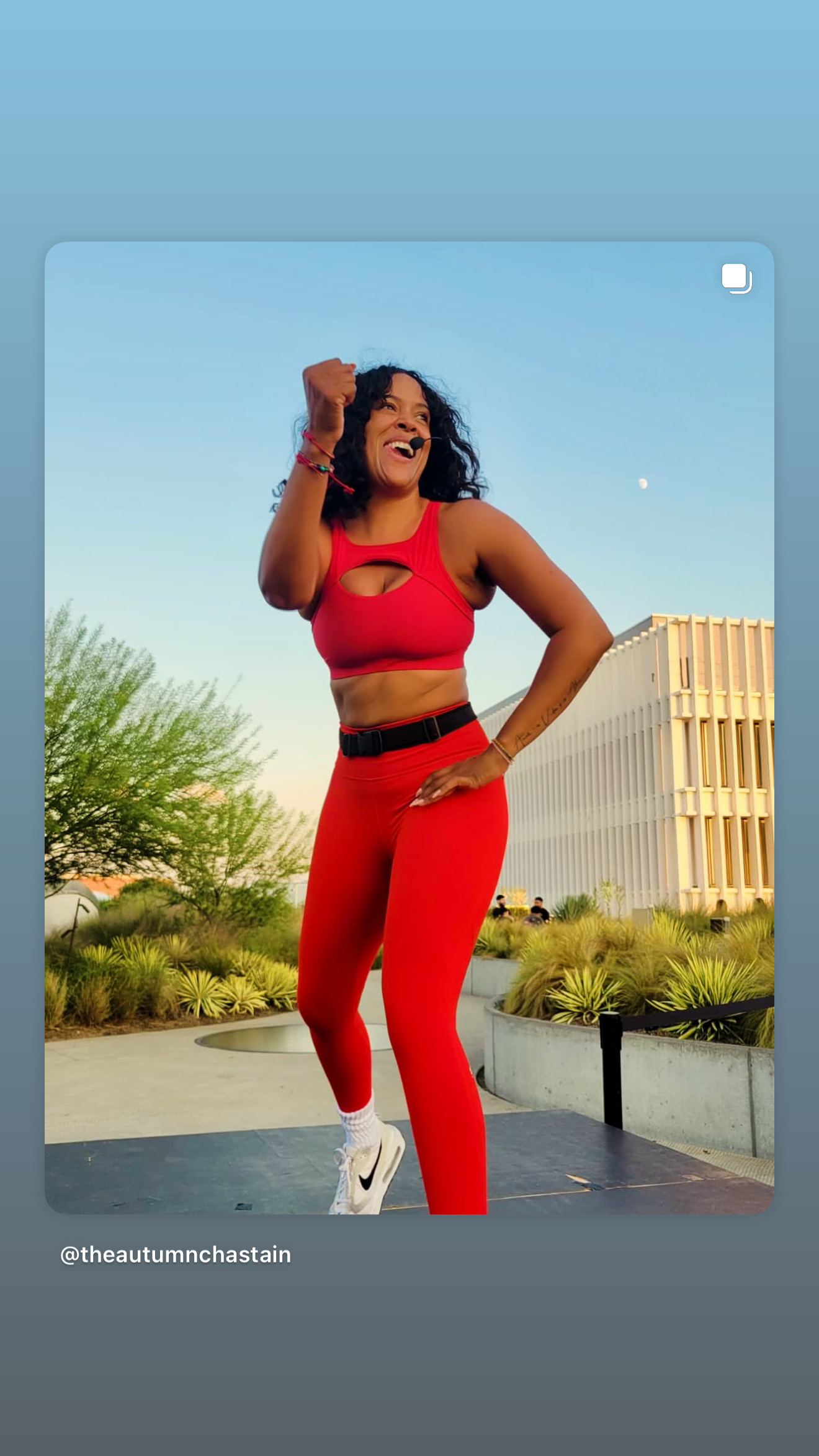
Speaking of the joy of movement, I see this all the time in my Houston community! Whether we are doing Zumba at Post Houston or gathering for a community walk, the energy is infectious. People aren't checking their watches every five minutes; they are laughing, sweating, and connecting.
Pro-tip for my Houston locals: If you want to experience movement without the data-stress, come join us!
First Thursday of every month: I teach Zumba at Post Houston at 6:30 PM.
Every other Thursday: Catch me at Trebly Park in Houston at 6:30 PM for more dance-filled fun.
Check the full event schedule to find the next session. There is no better way to practice body reconnection than through rhythm and community.
Finding the Middle Ground: A Balanced Approach to Tracking
I’m not saying you have to throw your Apple Watch or Oura Ring into the nearest river (those things are expensive!). But if you feel like your relationship with your tracker is becoming a bit... toxic, it might be time for a "Tracker Sabbatical."
Here is how to navigate a healthier relationship with your data:
The "Naked" Workout: Once a week, leave the watch at home. Go for a run, a walk, or a gym session completely untracked. Focus on your Perceived Rate of Exertion (RPE). How hard do you feel like you’re working on a scale of 1-10? Trust that feeling.
Use it for Awareness, Not Judgment: Use the data as a broad trend over months, not a daily verdict on your humanity. If your steps are down this week because you were busy crushing a project at work, give yourself grace.
Prioritize the "Feel Good" Metrics: Instead of steps, track how you felt after the workout. Did you feel energized? Calm? Strong? These are the metrics that actually lead to long-term lifestyle wellness coaching success.
Join a Community: Sometimes, we track because we are lonely and want to feel like we are part of something (shoutout to those Strava kudos!). Replace the digital "ping" with a real-life "high five." Join our Stryd Walk Club to meet real people who care more about the conversation than your average pace.

The High Achiever’s Pivot
For the high-achieving woman, data feels like control. If we can measure it, we can manage it, right? But health isn't a project management spreadsheet. It’s a living, breathing, fluctuating ecosystem.
When you lean into lifestyle wellness coaching, you learn that "rest" isn't a lack of productivity: it’s a prerequisite for it. Your tracker might tell you to "keep going" to hit a goal, but your body might be screaming for a nap. Learning to prioritize the body over the beep is the ultimate power move.
If you’re struggling to find that balance, a retreat can be a massive game-changer. It’s an opportunity to unplug from the "grid" and plug back into yourself. My Presence: A Holiday Retreat is designed exactly for this: to help you find stillness and reconnection in a world that demands constant output.
Final Thoughts: You Are More Than a Number
At the end of the day, a fitness tracker is a tool, not a master. If it motivates you to move more and makes you feel empowered, keep it. But the second it starts making you feel "less than," "lazy," or "guilty," it’s time to take it off.
You do not need a device to tell you that you are doing a good job. You do not need a "ping" to validate your effort. Your worth is not measured in steps, calories, or minutes of "intense activity."
Find movement that makes you smile. Find movement that makes you feel strong. Find movement that you’d do even if no one: and no device: was watching.

Are you ready to stop tracking and start living? Let’s work together on a personalized approach to mindful movement and body reconnection coaching. Whether it's through one-on-one coaching or joining us at one of our upcoming Houston events, the goal is always the same: finding joy in the skin you’re in.
See you on the dance floor (or the walking trail): watch or no watch!
Comments